
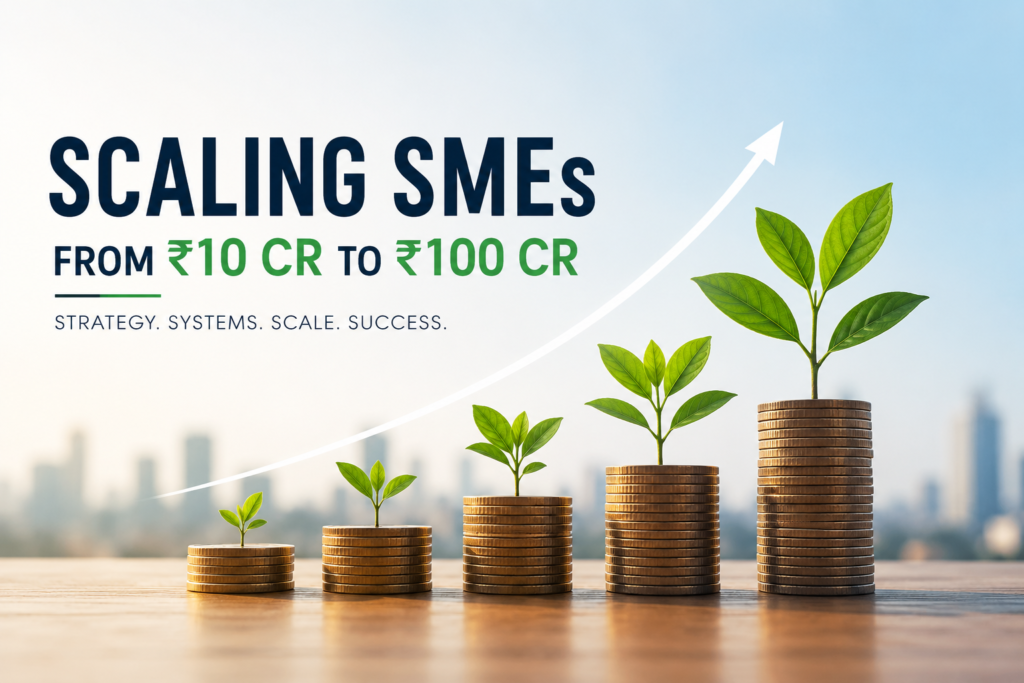
Scaling SMEs from ₹10 Crore to ₹100 Crore: The Complete Growth Blueprint for Business Owners
Reaching ₹10 crore in annual revenue is a significant achievement. It reflects years of hard work, customer trust, and entrepreneurial resilience. Yet, for many small and medium sized enterprises (SMEs), this milestone also marks the beginning of a new challenge.
The strategies that helped build a ₹10 crore business are often not enough to create a ₹100 crore enterprise.
Many business owners continue relying on founder-led decision-making, manual operations, informal processes, and reactive planning. As revenue grows, these practices create bottlenecks that slow expansion, reduce profitability, and increase operational risk.
Scaling is not simply about selling more. It requires building an organization that can grow consistently without becoming dependent on the founder for every decision.
Businesses that successfully scale from ₹10 crore to ₹100 crore typically invest in five core areas:
- Strategic direction
- Leadership capability
- Operational excellence
- Financial discipline
- Scalable systems and technology
This guide explores the framework successful SMEs use to transition from entrepreneurial businesses into professionally managed, growth oriented organizations.
Why Most SMEs Never Reach ₹100 Crore
Thousands of Indian SMEs cross ₹10 crore in revenue, but only a small percentage sustain the momentum needed to become ₹100 crore enterprises.
The reasons are rarely a lack of demand or opportunity. More often, growth stalls because the business outgrows the systems, leadership, and processes that once worked.
Common challenges include:
- Founder dependent decision making
- Inconsistent sales performance
- Weak middle management
- Poor cash flow planning
- Inefficient operations
- Lack of documented processes
- Limited use of technology
- Hiring without capability planning
- No long-term strategic roadmap
- Inadequate performance measurement
At this stage, growth requires a shift from managing daily operations to building an organization that can perform independently and consistently.
Running a business focuses on delivering today's results. Scaling a business focuses on creating tomorrow's capacity.
| Running a Business | Scaling a Business |
|---|---|
| Founder makes most decisions | Leadership team makes decisions |
| Manual workflows | Standardized systems and SOPs |
| Revenue driven by individual effort | Revenue driven by repeatable processes |
| Local customer base | Multi region or national expansion |
| Short term planning | Long term strategic planning |
| Reactive problem-solving | Proactive risk management |
| Functional silos | Cross-functional collaboration |
| Informal performance reviews | Data-driven KPIs and dashboards |
The transition from operator to strategic leader is one of the most important shifts a founder must make.
The Five Growth Stages of an SME
Understanding your current stage helps identify the capabilities required for the next level of growth.
Stage 1 – Survival (₹0–₹2 Crore)
The founder is deeply involved in every activity. The focus is on acquiring customers, maintaining cash flow, and validating the business model.
Stage 2 – Stability (₹2–₹10 Crore)
The business begins to build teams, establish recurring customers, and improve operational consistency. Informal systems often emerge during this phase.
Stage 3 – Structured Growth (₹10–₹25 Crore)
The organization needs professional management, documented processes, financial controls, and stronger accountability. Many businesses struggle here because founder led management becomes a constraint.
Stage 4 – Scalable Enterprise (₹25–₹50 Crore)
The focus shifts toward market expansion, leadership development, technology integration, and operational efficiency. Decisions become increasingly data-driven.
Stage 5 – Growth Organization (₹50–₹100 Crore)
Businesses at this stage operate with mature governance, scalable systems, strong leadership pipelines, robust financial planning, and continuous innovation. The founder's role evolves from day-to-day management to strategic direction.
Build a Clear Strategic Roadmap
Businesses rarely reach ₹100 crore through short term thinking. Sustainable growth requires a long term vision supported by measurable execution.
Every scaling business should define:
- A three to five year growth vision
- Annual strategic priorities
- Quarterly execution plans
- Revenue and profitability targets
- Market expansion strategy
- Product and service roadmap
- Customer acquisition goals
- Investment priorities
- Risk mitigation plans
A clear roadmap aligns leadership, improves decision-making, and ensures that daily activities contribute to long-term objectives rather than isolated short-term wins.
At IMPSTRA Business Consulting, we help SMEs build scalable businesses by aligning strategy, sales, finance, operations, HR, and technology into one integrated growth ecosystem. Through our Business Decode™ framework and hands on implementation, we identify growth bottlenecks, streamline processes, strengthen leadership, and implement scalable systems that enable businesses to grow from ₹10 Crore to ₹100 Crore with sustainable profitability.
- By admin
- No Comments